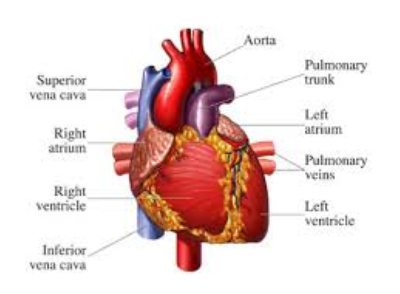
Aorta, Superior and Inferior vena cava, Pulmonary trunk, left and right atrium, left and right ventricle, Pulmonary veins
大動脈、上下大静脈、肺動脈、左心房・右心房、左心室・右心室、肺静脈
普段日本語では言い慣れない言葉ですが、英語の普段の会話には出てきたりします。なぜなら、アメリカでは医学医療分野の情報は日本ほど閉鎖されておらず、医師が患者に対してこういう語彙を使って疾患や症状を説明する場合が多く、患者もまたそれを習い使っています。
Task: Summarize the lecture orally in one minute.
A. The heart sits right in the center of the rib cage and between the two lungs. Below that, there is an important muscle, the diaphragm. By all of the above, called the thorax, the heart is protected and cased.
The body cells need nutrients oxygen, as well as their waste carbon dioxide to be removed. The main function of the heart is to provide the blood flow.
The functions of the heart are:
1) works as a pump to move blood constantly throughout the body, providing the systemic flow of blood. Blood is going out of the artery, the aorta, coming into a tubing through the superior vena cava and the inferior vena cava dragging blood in from all over the body into the heart.
2) also provides the pulmonary flow for blood to drop the waste carbon dioxide and pick up oxygen. Before the heart sends out the blood, the heart sends it over to the lungs; after blood comes back into the heart from the lungs, it is pushed out of the aorta.
3) has blood vessels all over it called coronary vessels that serve the heart itself. This flow of blood falls under the systemic flow.
これで1分です。

 Adamorbis 英語