Healthcare for English Learners - 医療口頭試験問題解答例

Heart

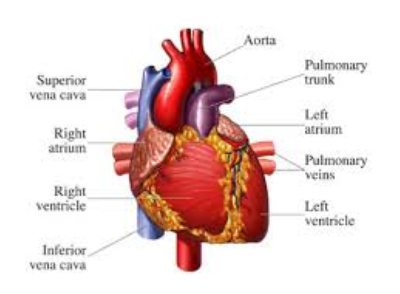
Aorta, Superior and Inferior vena cava, Pulmonary trunk, left and right atrium, left and right ventricle, Pulmonary veins

大動脈、上下大静脈、肺動脈、左心房・右心房、左心室・右心室、肺静脈

普段日本語では言い慣れない言葉ですが、英語の普段の会話には出てきたりします。なぜなら、アメリカでは医学医療分野の情報は日本ほど閉鎖されておらず、医師が患者に対してこういう語彙を使って疾患や症状を説明する場合が多く、患者もまたそれを習い使っています。

Task: Summarize the lecture orally in one minute.

A. The heart sits right in the center of the rib cage and between the two lungs. Below that, there is an important muscle, the diaphragm. By all of the above, called the thorax,  the heart is protected and cased.

The body cells need nutrients oxygen, as well as their waste carbon dioxide to be removed. The main function of the heart is to provide the blood flow.

The functions of the heart are:

1) works as a pump to move blood constantly throughout the body, providing the systemic flow of blood. Blood is going out of the artery, the aorta, coming into a tubing through the superior vena cava and the inferior vena cava dragging blood in from all over the body into the heart.

2) also provides the pulmonary flow for blood to drop the waste carbon dioxide and pick up oxygen. Before the heart sends out the blood, the heart sends it over to the lungs; after blood comes back into the heart from the lungs, it is pushed out of the aorta.

3) has blood vessels all over it called coronary vessels that serve the heart itself. This flow of blood falls under the systemic flow.

これで1分です。

Biology Anatomy of a Neuron for English Learners ー 生物学神経細胞の分析口頭試験回答例

さて、生物学神経細胞の分析口頭試験うまく話せましたか。

おかしな事をいうようですが、英語の話を聞いて、それについてスピーキング、つまり口頭で回答をする場合、語彙を始めすべて日本語でなんというかなど考えずに話してください。はっきり語彙が聞こえなくて、正しく発音できなくてもいいんです。それより、問の回答としてプレゼンテーションができることが大切です。語彙や動詞など、そのまま聞こえたとおりに使えばいいのです。

試験でも、実生活でも、日本語で考えているような間はありません。

回答例です。

My notes:

one of the most interesting cell of human body, the neuron – brain, nervous system, responsible for thoughts, feelings, sentience

a neuron, communication, transmit signals across its length.

body of a neuron = Soma, nucleus, stick out, branching, branches off soma, dendrites, the neuron receive signals

Tail, Axon, long, short, several feet, distance of the signals travel, at the end, axon terminal, connect to other dendrites, tissue, muscle, to tell something

axon hillock, connects the cell body to axon, impulses travel, insulating cells around axons, Schwann cells, covering, make up myelin sheaths, spaces between = nodes of Ranvier

signals transmitted, combined effects of signals summed up, large enough action potential, transmitted, synapses, via synapsis to another dendrites, axons, taste buds

1. Explain the anatomical structure of a neuron according to the lecture.

A sample answer: There is a body of the neuron called soma, where the nucleus is, from which branches called dendrites stick out and branch off. The soma has a trail called an axon that is connected via a part called an axon hillock. The axon could be several feet long and this is where the signals travel and it ends with axon terminals that spread out to transmit signals. The axon is covered for insulation by the cells called Schwann cells, which make up myelin sheaths. There are gaps between myelin sheaths, which  are called nodes of Ranvier.

2. How is a signal transmitted from one neuron to another?

A sample answer: A neuron transmits signals or communicates. When there are stimuli, dendrites act as the receivers of the signals. While the stimuli is small, nothing happens but when the combined effect of the signals is summed up large enough to gain action potential, the signals travel from the dendrites through the axon to the axon terminals where synapses receive the signals to transmit them to another dendrite for transmission, tissue and muscle to do something, or even taste buds to taste salt for example.